TinyML is a branch of machine learning designed to run on microcontrollers and embedded chips that have very little memory, processing power, and battery capacity. Instead of sending raw data to a cloud server for analysis, a TinyML model sits on the device and makes decisions locally in real time.
The “tiny” part refers to the hardware. A typical cloud AI model might need gigabytes of memory and a powerful graphics processing unit (GPU).
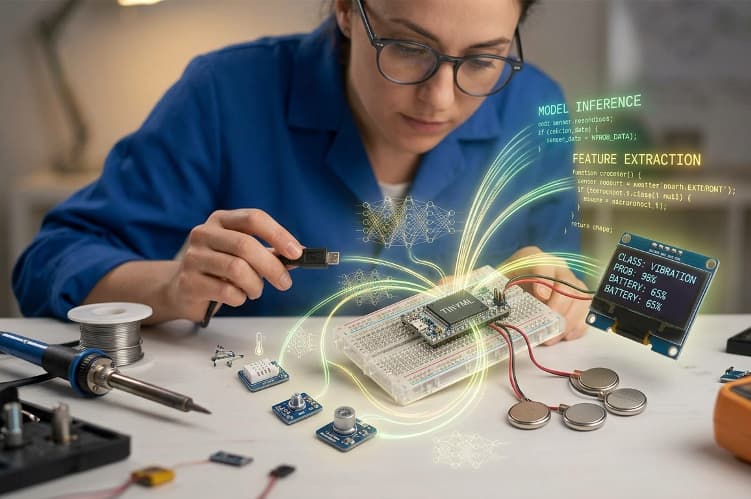
A TinyML model is compressed down to kilobytes and runs on a chip that costs less than one dollar. Think of it as fitting a trained expert brain into a chip the size of a fingernail, and then powering that chip with a small coin cell battery for months at a time.
TinyML is a subset of the broader field called edge AI (artificial intelligence that runs at the data source, or “edge,” rather than in a central data center).
The two terms are often used together, but TinyML specifically refers to the most resource constrained end of the edge AI spectrum, targeting microcontrollers rather than more powerful edge servers.
How TinyML Works: From Training to Deployment
TinyML follows a four step process from creation to use. Each step happens on different hardware, which is what makes TinyML both practical and efficient.
Step 1: Train the Model on a Powerful Machine
The machine learning model is first trained on a standard computer, laptop, or cloud server using large datasets.
Common training frameworks include TensorFlow, PyTorch, and Scikit Learn. This training phase can take hours or days and requires significant computing power, but it only happens once.
Step 2: Optimize and Compress the Model
After training, the model goes through compression techniques to shrink it down. The two main techniques are quantization and pruning.
Quantization reduces the numerical precision of the model weights (for example, converting 32 bit numbers to 8 bit numbers), which cuts file size dramatically.
Pruning removes connections in the neural network that have little impact on accuracy. The result is a model that might be 10 to 100 times smaller than the original, with only a small drop in accuracy.
Step 3: Convert to a Microcontroller Friendly Format
The compressed model is then converted into a format that a microcontroller can actually read and run. The most widely used tool for this is TensorFlow Lite for Microcontrollers, developed by Google.
Other options include Edge Impulse, MicroTVM, and ARM’s CMSIS NN library. These tools handle the translation between a standard model format and the stripped down code that fits into kilobytes of flash memory.
Step 4: Deploy and Run Inference on the Device
The converted model is loaded onto the microcontroller inside the target device. Once there, it runs what is called inference, meaning it takes in live sensor data (audio, motion, temperature, image pixels) and produces an output (a classification, a prediction, or a trigger). This inference happens in milliseconds, consumes very little power, and requires no internet connection.
| Step | What Happens | Where It Happens |
|---|---|---|
| Training | Model learns from large datasets | Cloud server or laptop |
| Optimization | Model is quantized and pruned to reduce size | Developer workstation |
| Conversion | Model is formatted for microcontrollers | Developer workstation |
| Inference | Model runs on live sensor data in real time | The device itself |
Read More: How to Use Router to Monitor Internet Activity
Why TinyML Matters: Three Core Advantages
No Internet Required
TinyML devices make decisions without sending data to a server. A keyword detection model in a smart speaker only wakes up when it hears the trigger word, and that detection runs entirely on the device chip.
No audio is streamed to the cloud until after the wake word is confirmed locally. This means the device works in areas with no internet, and it works instantly with near zero latency.
Privacy by Design
Because raw sensor data stays on the device, TinyML offers stronger privacy than cloud dependent AI. Your smartwatch analyzing your heart rhythm never needs to upload raw biometric data to a third party server.
The analysis happens on your wrist, and only a summary result is ever shared. This is a significant advantage for healthcare and consumer applications where personal data sensitivity is high.
Energy Efficiency
TinyML models are built to run on microcontrollers that draw milliwatts or even microwatts of power.
A fitness tracker running a TinyML activity classifier can operate continuously for days or weeks on a small battery. Cloud AI requires a constant data connection, which consumes far more power due to radio transmission alone. TinyML removes that energy cost entirely.
How TinyML is Used in Everyday Devices
TinyML is already running inside products that millions of people use daily. Here are the most common applications by category.
Smart Speakers and Voice Assistants
Every smart speaker on the market uses TinyML for wake word detection. The phrases “Hey Siri,” “Alexa,” and “OK Google” are detected by a small on device model that listens continuously for that specific audio pattern.
Only after the wake word is detected does the device connect to the cloud to process the full command. This approach saves enormous amounts of bandwidth and ensures the speaker is not streaming audio to a server all day.
Fitness Trackers and Smartwatches
Wearable devices use TinyML models to classify physical activity, detect falls, monitor heart rate patterns, and flag irregular heartbeats. The on device processing means these features work even when the watch is in airplane mode or out of range of a phone.
Smart Home Thermostats and Sensors
Thermostats from companies like Google Nest use on device models to learn occupancy patterns and adjust temperature automatically.
Motion sensors and door sensors often run TinyML classifiers to distinguish between a person walking past and a pet moving through the room, reducing false alarms without requiring any cloud lookup.
Smart earbuds with TinyML capabilities can also adapt audio processing based on background noise levels detected in real time.
Hearing Aids and Medical Devices
Hearing aids are one of the earliest mass market TinyML products. Modern hearing aids run sound classification models that differentiate speech from background noise and adjust amplification accordingly.
These models must run on chips smaller than a grain of rice and last for days on a tiny battery, which is exactly the environment TinyML is built for.
Continuous glucose monitors are another growing example, using on device ML inference to analyze blood sugar trends without constant cloud dependency.
Industrial Sensors and Predictive Maintenance
In factories, TinyML models run on vibration sensors attached to motors and pumps. The model learns the normal vibration signature of a healthy motor and triggers an alert when patterns shift, indicating early bearing wear or imbalance. This is called predictive maintenance.
Automotive Safety Systems
Cars use TinyML for in cabin detection tasks such as driver drowsiness monitoring, gesture recognition for infotainment controls, and occupant detection for airbag calibration.
These functions must respond in under 100 milliseconds and cannot depend on a cloud connection. TinyML models running on dedicated automotive microcontrollers handle all of these tasks locally.
TinyML Hardware: What Devices Actually Run It?
TinyML runs on a specific category of chips called microcontrollers (MCUs).
These are different from the processors in smartphones or laptops. MCUs have very little RAM (often 256 kilobytes or less), no operating system in the traditional sense, and are designed to run a single dedicated task reliably and efficiently for years.
Common hardware platforms for TinyML include:
- ARM Cortex M series microcontrollers are the most widely used MCU architecture in the world and serve as the hardware base for most TinyML deployments.
- Arduino boards provide an accessible entry point for developers learning TinyML.
- Raspberry Pi Pico is a low cost board popular for prototyping TinyML applications.
- Nordic Semiconductor, STMicroelectronics, and NXP chips are widely used in commercial products for their energy efficiency and AI support.
- Texas Instruments MSPM0 MCUs, launched in March 2025, are among the smallest available and measure just 1.38 square millimeters, making them suitable for earbuds and medical probes.
TinyML vs Cloud AI: When to Use Which
Not every AI task belongs on a microcontroller. TinyML is the right tool for specific scenarios, and cloud AI remains the better option for others.
| Factor | TinyML | Cloud AI |
|---|---|---|
| Internet required | No | Yes |
| Latency | Under 10 milliseconds | 100 to 2,000 milliseconds |
| Privacy | High, data stays on device | Lower, data sent to server |
| Power consumption | Very low (milliwatts) | High (constant radio use) |
| Model complexity | Simple to moderate | Unlimited |
| Cost per inference | Near zero after deployment | Ongoing API and server costs |
| Best use case | Sensors, wearables, always on detection | Complex reasoning, large language models, image generation |
The general rule is: use TinyML when the device needs to react instantly, work without internet, or preserve battery life.
Use cloud AI when the task requires large model complexity, processing power that exceeds what a microcontroller can handle, or access to constantly updated data.
Conclusion
TinyML brings AI off the server and into the objects around you. It is what makes your smoke alarm smarter, your hearing aid more natural, and your fitness tracker accurate without draining its battery in a day.
The technology is not a replacement for cloud AI. It is the layer of intelligence that runs where cloud AI cannot reach: in the field, on the wrist, in the car, and inside a chip the size of a sesame seed.
As microcontroller hardware becomes cheaper and model compression tools become more accessible, TinyML will become a standard feature of nearly every connected device produced. The question is no longer whether embedded AI is possible. It is how small and how efficient it can get.
Comments are closed, but trackbacks and pingbacks are open.