LTE-M vs NB-IoT: Which One Should You Choose for IoT?

LTE-M and NB-IoT are both cellular technologies built for the Internet of Things (IoT). They run on licensed mobile spectrum, which means they use the same towers and infrastructure as regular 4G and 5G networks rather than needing new hardware installed nearby.

LTE-M stands for Long Term Evolution for Machines. It is a lighter version of standard LTE, designed for devices that need more data, mobility, and even voice support, while still saving battery compared to full 4G modems.
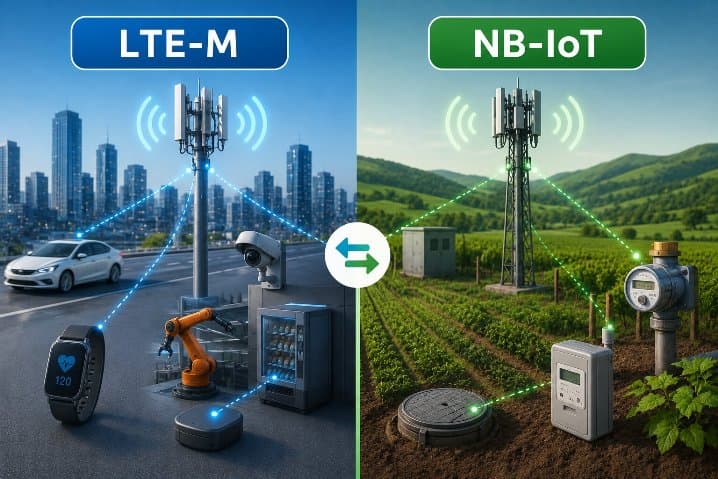
LTE-M vs NB-IoT

NB-IoT stands for Narrowband IoT. It uses a much smaller slice of spectrum than LTE-M, which trades speed for better range, lower cost hardware, and longer battery life. It works well for devices that sit in one place and report small amounts of data on a set schedule.

Key Takeaways
• LTE-M wins on speed, latency, mobility, and voice support.
• NB-IoT wins on battery life, indoor penetration, and hardware cost.
• Data rate gap is large: up to 4 Mbps for LTE-M on 5G versus up to 127 kbps for NB-IoT on 5G (Lansitec, 2026).
• NB-IoT fits static, low data devices like meters and sensors. LTE-M fits moving or voice enabled devices like trackers and alarms.
• Coverage and pricing both vary by carrier and country, so confirm local support before choosing either technology.

How LTE-M and NB-IoT Work

Both technologies operate inside existing LTE networks, but they use different amounts of bandwidth and different power saving methods to reach their goals.

LTE-M uses a 1.4 MHz channel, the same width as one standard LTE resource block. This wider channel is what allows LTE-M to move more data per second and support features like voice calls and network handovers as a device moves between cell towers.

NB-IoT uses just 200 kHz of spectrum, equal to one physical resource block inside a normal LTE channel. This narrow channel lets carriers fit many more NB-IoT devices into the same spectrum, and it improves signal quality at long range, but it limits how much data a device can send at once.

Both technologies also rely on Power Saving Mode (PSM) and extended Discontinuous Reception (eDRX), which let a device’s radio sleep for long stretches between transmissions instead of staying connected around the clock.

Data Rate and Latency Compared

LTE-M moves data faster and responds quicker than NB-IoT, which is why it fits applications that need near real time updates.

On 4G networks, LTE-M reaches up to 1 Mbps in both directions. On newer 5G deployments, that climbs to 4 Mbps.

Latency for LTE-M runs as low as 100 ms in some deployments, which is close enough to real time for applications like fleet tracking and connected vehicles.

NB-IoT is far slower by design. On 4G networks it tops out around 26 kbps, rising to 127 kbps on 5G.

Latency is also much higher, often around 10 seconds, since NB-IoT devices sleep for long periods to save power and only wake on a schedule.

If a project needs to send more than a short status update, or needs a response within a second or two, LTE-M is the only realistic option between the two.

Read Also: When Should You Use WiFi Instead of LoRa?

Power Consumption and Battery Life

NB-IoT uses less power than LTE-M under most conditions, which is the main reason carriers pitch it for long lived, unattended sensors.

NB-IoT devices can run for five to ten years on a single AA battery when configured with PSM and eDRX, because the narrow channel and infrequent reporting schedule keep the radio off most of the time.

LTE-M devices consume more power in comparison, mainly because their wider bandwidth and support for mobility and voice keep the modem more active.

There is a nuance worth knowing here. Because LTE-M transmits data faster, it can sometimes finish a transmission and return to sleep sooner than NB-IoT for the same payload, which narrows the power gap in real world testing.

The difference depends heavily on payload size, reporting frequency, and network configuration, not just the radio technology alone.

Coverage, Range, and Indoor Penetration

NB-IoT generally reaches deeper into basements, underground utility vaults, and metal enclosures than LTE-M, thanks to its narrow channel and higher tolerance for signal loss.

NB-IoT’s link budget is roughly 20 dB better than standard LTE, which is why carriers market it for water meters in underground vaults and sensors buried in concrete.

Industry figures put NB-IoT’s maximum coupling loss at 164 dB, compared with 160.7 dB for LTE-M on 4G networks, though LTE-M closes that gap to 164 dB on 5G deployments.

In open outdoor conditions, the two technologies perform more similarly, and some field testing has found LTE-M connects to a base station at greater range than NB-IoT under certain network configurations.

Coverage in practice depends heavily on the carrier’s network design in a given region, so real world testing at your deployment site is the only way to know for sure.

Cost and Deployment Considerations

NB-IoT modules are typically cheaper than LTE-M modules, since the simpler radio design needs less complex hardware.

Because NB-IoT devices send small amounts of data infrequently, carriers often price plans around a low, flat access fee per device rather than data volume.

LTE-M plans, by contrast, are more likely to include a data allowance given the technology’s support for larger payloads and more frequent transmissions.

Before locking into either technology, confirm that your carrier and region actually support it. Coverage and roaming agreements for both LTE-M and NB-IoT still vary by country and by carrier, so checking local network maps before committing to hardware is a required step.

Which One Should You Choose Between LTE-M & NB-IoT?

Pick LTE-M if your device moves, needs voice, or sends more than a small status packet on a frequent basis.

Fleet tracking, micromobility, wearables, security alarms, and any application needing firmware updates over the air all fit LTE-M’s strengths.

Pick NB-IoT if your device stays in one place, reports small amounts of data on a fixed schedule, and needs to run for years without a battery change.

Smart water and gas meters, environmental sensors, and underground infrastructure monitoring are the clearest use cases.

Some projects use both. A logistics company might use LTE-M on vehicles for real time location updates and NB-IoT on warehouse sensors that only need to report temperature once an hour.

Conclusion

LTE-M and NB-IoT solve different problems even though both run on the same underlying cellular networks.

LTE-M is the right choice when a device moves, needs a fast response, or requires voice support.

NB-IoT is the right choice when a device sits still, reports small amounts of data rarely, and needs to run for years on a small battery.

Matching the technology to the device’s actual behavior, rather than picking whichever sounds more advanced, is what determines whether an IoT deployment works well in the field.

Comments are closed, but trackbacks and pingbacks are open.