Z-Wave and Z-Wave Plus are two generations of the same smart home radio protocol, not two competing standards.
Z-Wave Plus is the newer, faster, and more power efficient version, and almost every device sold today is built on it or on its successor, Z-Wave Plus v2.
If you are shopping for smart locks, sensors, or switches, knowing which generation a product uses tells you a lot about its range, battery life, and how well it will play with the rest of your setup.
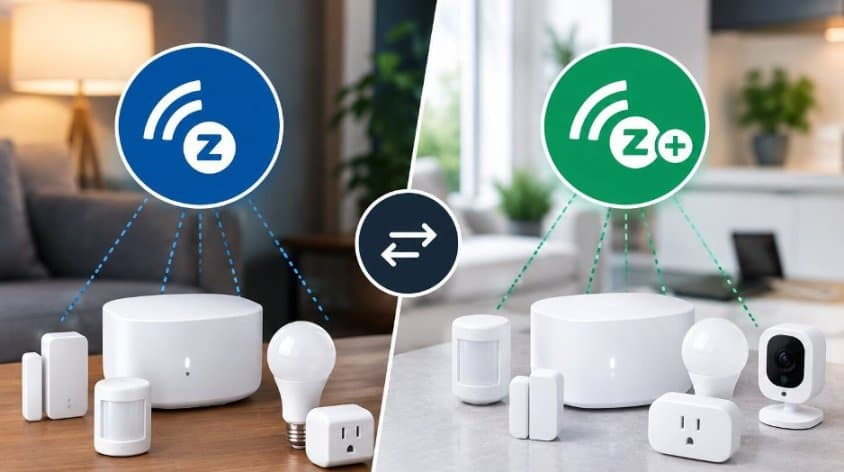
What is Z-Wave?
Z-Wave is a low power wireless protocol used to connect smart home devices such as door locks, light switches, thermostats, and sensors.
It operates on the sub 1 GHz radio band, which travels farther through walls than Wi-Fi or Bluetooth and avoids congestion with your home network.
Every Z-Wave device also acts as a signal repeater. This creates a mesh network, meaning a message from your hub can hop from device to device until it reaches its target, even if that target is out of direct range of the hub.
The original Z-Wave protocol launched on 300 Series chips and became widespread in North America starting around 2005.
What is Z-Wave Plus?
Z-Wave Plus is the certification introduced in March 2013 for devices built on 500 Series chips.
It kept the same core mesh networking approach as classic Z-Wave but improved almost every technical spec around it, from radio efficiency to how devices join the network.
A product can only carry the Z-Wave Plus logo if it passes the Z-Wave Alliance certification program for that generation, which is meant to guarantee interoperability across brands.
The badge provides a quick way to identify whether a product uses classic Z-Wave or the newer Z-Wave Plus technology.
See More: Zigbee vs Thread: Which Smart Home Protocol Should You Choose?
Z-Wave vs Z-Wave Plus: Features and Differences
| Feature | Classic Z-Wave | Z-Wave Plus |
|---|---|---|
| Chip generation | 300 Series | 500 Series |
| Year introduced | Around 2005 | 2013 |
| Battery life | Baseline | About 50 percent longer |
| Range | Baseline, roughly 100 feet indoors | Extended, roughly 130 feet indoors or more depending on the source |
| Bandwidth | Baseline | Up to 250 percent more data throughput |
| RF channels | One primary channel | Three channels for less interference |
| Network joining | Manual pairing only | Plug and play network wide inclusion |
| Firmware updates | Not supported | Over the air (OTA) updates supported |
| Self healing diagnostics | Limited | Explorer Frame feature for automatic issue detection |
| Backward compatibility | N/A | Fully compatible with classic Z-Wave devices |
Why Range and Battery Life Improved So Much
The jump in performance comes down to a more efficient chipset, not a change to the radio frequency itself.
The 500 Series chip used in Z-Wave Plus draws less current per transmission, so a sensor running on a coin cell battery can often last several years longer between replacements.
Range improved for a similar reason. Better receiver sensitivity on the newer chip means each device in the mesh network can pick up a usable signal from farther away, so fewer hops are needed to cover the same house.
Reported gains vary by source and test setup, generally landing somewhere between 50 and 67 percent more range than classic Z-Wave.
What Changed With Z-Wave Plus v2
Z-Wave Plus v2 is the certification that applies to devices built on 700 Series chips, announced in 2019, and 800 Series chips, released in 2022.
This is the generation almost all new Z-Wave products ship with today, and it made 128 bit S2 security mandatory rather than optional, along with further gains in range, battery life, and processing power.
The 800 Series chip also added support for Z-Wave Long Range, a separate mode that lets a device talk directly to the hub across distances of up to a mile in open air, skipping the mesh hop process entirely.
Z-Wave Long Range is a distinct topology from the standard mesh network and is worth treating as its own topic rather than a simple range upgrade.
Does Everything Still Work Together
Yes. Every generation of Z-Wave, from classic to Z-Wave Plus v2, is designed to be backward and forward compatible on the same network.
You can add a ten year old classic Z-Wave motion sensor to a hub running mostly Z-Wave Plus v2 devices and it will join the mesh without issue.
The catch is that the older device will not gain the newer benefits. It will still have shorter battery life and shorter range than its neighbors, and it will not support features like OTA updates or Explorer Frame diagnostics, since those depend on the chip inside the device itself.
Conclusion
Z-Wave Plus is not a competing standard to Z-Wave. It is the same mesh networking approach running on a more efficient chip, with real gains in battery life, range, bandwidth, and diagnostics.
Classic Z-Wave hardware still works and still joins modern networks, but new purchases should target Z-Wave Plus v2 devices on 700 Series or 800 Series chips, since that is where current security requirements and performance improvements live.
Check for the certification logo before buying, and you will avoid ending up with the slowest link in your mesh.
Comments are closed, but trackbacks and pingbacks are open.