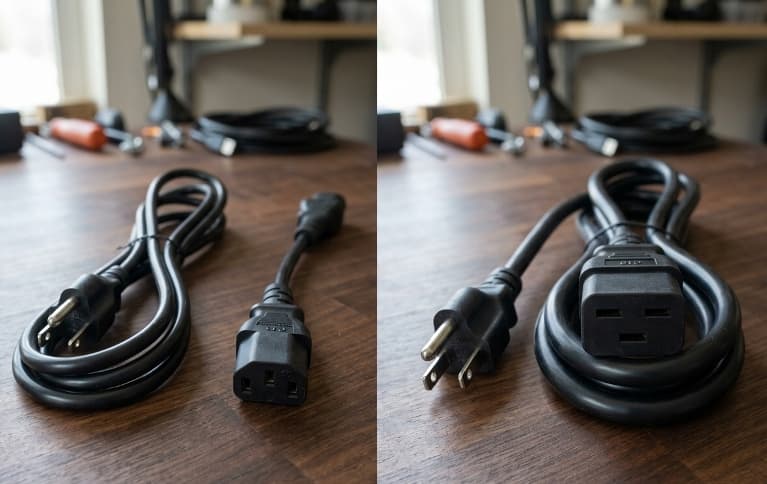
A C19 power cord is built for higher amperage than a C13 cord, and it has a larger connector and thicker wires to match.
C13 is the everyday connector. It sits on the end of most desktop PC, monitor, and printer cables. C19 is the heavy duty version, used where a single device pulls a lot of power.
Its power supplies rated at 1500 W and above ship with a C19 connector, while its lower wattage units use C13.
What Are C13 and C19 Connectors?
C13 and C19 are connector types defined by IEC 60320, the international standard for appliance couplers.
IEC stands for International Electrotechnical Commission. A coupler is the pair of parts that join a cord to a device: a female connector on the cord and a male inlet on the equipment.
Each connector has a mating inlet with the next number up. C13 plugs into C14, and C19 plugs into C20.
Think of it like a key and lock system. The cord end is the key, and the inlet on the device is the lock.
A C19 key will not fit a C14 lock, which protects a small device from being fed a cord meant for a much bigger load.
Check Also: Cat 4 vs Cat 5 vs Cat 6 Ethernet Cables
C13 vs C19 Amp Ratings: International and North American Numbers
Under IEC 60320, C13 is rated at 10 A and C19 at 16 A, both at 250 V and 70° C. North American standards rate the same connectors higher.
The United States and Canada rate a C13 at up to 15 A under UL 498 and UL/CSA 60320 1, while most other countries follow IEC 60320 1 and rate it at 10 A.
Cords sold in North America carry the rating of their own national listing. A heavy duty C19 to C20 cord is commonly listed at 20 A, 250 V on 12 AWG wire.
Always read the rating printed on the cord or its listing label. Two cords with the same connector shape can carry different ratings depending on where they were made and certified.
How Many Watts Can a C13 or C19 Cord Handle?
Watts equal volts times amps. At 230 V, a 10 A C13 cord tops out around 2,300 W, and a 16 A C19 cord tops out around 3,680 W.
At 120 V with North American ratings, a 15 A C13 reaches 1,800 W and a 20 A C19 reaches 2,400 W.
These are ceiling figures, not targets. Equipment should draw less than the cord rating during normal use, so pick a cord with headroom above the device’s nameplate load.
C13 and C19 describe the connector and its current rating, not the supply voltage. Both are used at 120 V and at 208 to 240 V.
Physical Differences Between C13 and C19 Cords
A C19 connector is visibly larger than a C13, and the cable attached to it is usually thicker because it needs a larger wire gauge inside.
Wire gauge is the thickness of the copper conductor. Thicker wire resists heat better at higher current.
C13 is compact, which suits high density racks and small devices. C19 takes up more space and needs a matching C20 inlet.
Those size differences are deliberate. The bigger body and different shape keep a C19 cord from mating with a C14 inlet by accident.
Which Devices Use a C13 Cord and Which Use a C19 Cord
C13 cords connect low to moderate power devices. C19 cords connect equipment with heavy, sustained draw.
| Cord | Typical Devices |
|---|---|
| C13 | Desktop PCs, monitors, printers, switches, standard servers |
| C19 | High power servers, blade chassis, large storage arrays, big UPS units, PDU high current inputs |
A PDU is a power distribution unit, the outlet strip used in server racks.
Many PDUs offer both C13 and C19 outlets, and the C19 outlets are reserved for the highest power devices. Check which outlet type your PDU has before you order cords.
Can You Use a C13 Cord in a C19 Outlet or the Other Way Around?
You can find adapters that convert between the two, but an adapter does not change what the equipment can safely carry. The lowest rated element in the path sets the limit for the whole path.
For example, a C13 cord fed from a C19 outlet through an adapter is still a 10 A path under IEC ratings. Plugging a small cord into a big outlet gives you no extra capacity.
Adapters make sense for temporary or retrofit situations. For a permanent setup, buy a cord that matches the device inlet and the outlet directly.
How to Choose Between a C13 and C19 Power Cord
Match the cord to the device, then to the outlet. Follow these steps.
- Look at the inlet on the device. If it is a C14, you need a C13 cord. If it is a C20, you need a C19 cord.
- Read the device nameplate for its rated amps or watts, and confirm the cord rating is higher than that load.
- Check the outlet at the other end. Confirm the plug type fits your wall socket or PDU outlet.
- Confirm the cord carries a listing that fits your region, such as UL in North America.
- Choose the length you need and avoid coiling a loaded cord tightly, since coils trap heat.
Final Verdict
Buy a C13 cord for standard electronics with a C14 inlet, and a C19 cord for high power equipment with a C20 inlet. The inlet on your device decides the answer.
Before you order, check the cord’s amp rating against the device’s nameplate load and the standard that applies in your country. If the numbers are close, go to the higher rated cord.
Comments are closed, but trackbacks and pingbacks are open.