Zigbee and Thread are the two most common low power wireless protocols behind smart home devices like bulbs, sensors, locks, and thermostats.
Both build a mesh network so devices can relay signals to each other instead of relying on a single router. The real difference comes down to what sits on top of each protocol, how they handle internet connectivity, and which one your hub or app actually supports.
This article breaks down how each protocol works, where they diverge, and how to decide between them for a new or growing smart home setup.
Key Takeaways
|
What is Zigbee?
Zigbee is a complete wireless communication stack built specifically for low power devices that need to run for months or years on a small battery. It handles everything from the radio signal to the application layer in one package.
Zigbee runs on the IEEE 802.15.4 radio standard, mostly in the 2.4 GHz band, with some regional versions using 868 or 915 MHz.
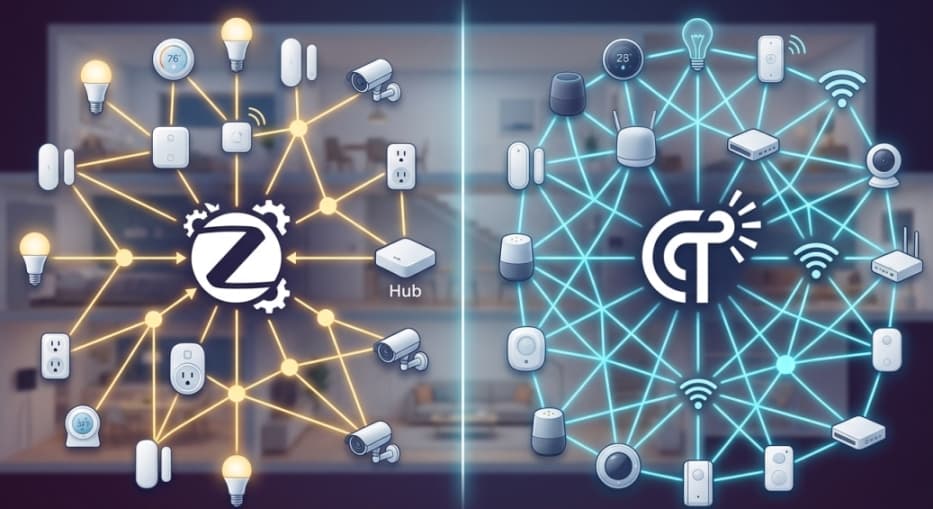
Devices form a self healing mesh, meaning a bulb or plug can relay a signal from a distant sensor to your hub even if a router node fails.
A Zigbee network needs three types of nodes to function: a coordinator that manages the network and handles new devices joining, routers that pass messages along and are usually mains powered devices like smart plugs, and end devices such as battery powered sensors that only join through a router.
Because Zigbee predates Matter, most Zigbee devices talk to your app through a proprietary hub, such as a Philips Hue Bridge or a SmartThings hub, unless that hub adds a Matter bridge on top.
What Is Thread?
Thread is an open mesh networking protocol built around IPv6, which means every device on a Thread network gets its own unique internet style address instead of relying on a proxy hub to translate its messages.
Thread also runs over IEEE 802.15.4 radio hardware in the 2.4 GHz band, so the physical radio is similar to Zigbee, but the network and software layers on top are different.
Thread was built from the start to support Matter, the cross brand smart home standard backed by Apple, Google, Amazon, and Samsung.
A Thread network needs a border router, a small piece of hardware that connects the low power mesh to your regular Wi-Fi or Ethernet network and, through that, to the internet.
Many current smart speakers, streaming boxes, and mesh Wi-Fi routers already include a Thread border router, so adding Thread devices to an existing Apple Home or Google Home setup often does not require a separate purchase.
How Range and Reliability Compare
Both protocols use mesh networking, so range depends more on the number of mains powered relay devices in your home than on either protocol’s raw radio strength.
A single Zigbee or Thread device might only reach 10 to 20 meters indoors, but a mesh with several plugs, bulbs, or outlets in between can cover a large house.
Independent testing on real hardware found that Zigbee and Matter over Thread each have strengths depending on network size and traffic pattern, with Zigbee showing an edge in some efficiency measures and Thread scaling differently under heavier IP based traffic.
Neither protocol is simply faster or more reliable across every scenario, so the practical difference in a typical home is often small.
Explore This: LoRa vs WiFi: Which Wireless Technology Fits Your Project
Power Consumption and Battery Life
Both Zigbee and Thread were designed around the same goal: let a sensor run for a year or more on a coin cell battery. Both achieve this by keeping most end devices asleep and only waking them briefly to send or receive data.
Thread’s IPv6 based addressing does add a small amount of overhead compared to Zigbee’s leaner proprietary packets, but manufacturers have optimized this enough that real world battery life between a Zigbee sensor and a Thread sensor is rarely a deciding factor for most households.
Interoperability and the Role of Matter
Matter is not a competing radio protocol. It is an application layer that defines how a device describes itself and responds to commands, and it can run over Wi-Fi, Ethernet, or Thread.
Thread is one of Matter’s native transport options, which is why almost every new Thread device released in 2026 is also Matter certified out of the box.
Zigbee does not speak Matter natively. To bring a Zigbee light or sensor into a Matter based app like Apple Home or Google Home, you need a hub that includes a Zigbee to Matter bridge, such as newer Amazon Echo devices, Aqara hubs, or SmartThings hubs.
This works well in practice, but it adds a translation step that a native Thread device skips entirely.
Security Differences
Zigbee uses network wide encryption keys, and in most consumer setups a single key protects the whole mesh, which means a compromised device can, in rare cases, expose that key to an attacker on the same network.
Thread uses per device authentication and encryption based on IPv6 security standards, giving each device its own credentials rather than one shared key for the entire mesh.
In practice, both protocols are considered secure enough for home use when devices are kept updated and bought from reputable brands, but Thread’s architecture gives it a structural edge for larger networks.
Which Protocol Should You Choose
The right protocol depends on what you already own and which app you plan to control everything from, not on which technology sounds newer.
If you already have a Zigbee hub such as a Hue Bridge, SmartThings hub, or Aqara hub with working devices, keep using it. Zigbee still has the largest catalog of bulbs, sensors, and plugs available today.
If you are building a smart home from scratch and plan to use Apple Home, Google Home, or Amazon Alexa, look for Thread and Matter certified devices first.
You get native cross brand support without needing a bridge, and manufacturers are prioritizing Thread for new sensor and lock designs going forward.
If you use Home Assistant or another open platform, both protocols work well through a Zigbee coordinator (such as a Sonoff or ConBee dongle) alongside a Thread border router, so you are not forced to pick only one.
Conclusion
Zigbee and Thread solve the same core problem, low power mesh networking for smart home devices, using different approaches.
Zigbee remains the more mature option with the larger device catalog, while Thread is becoming the default choice for new Matter certified hardware because it avoids the need for a translation bridge.
Neither protocol is disappearing soon, and the practical choice usually comes down to which hub and app ecosystem you already use rather than the underlying radio technology itself.
Comments are closed, but trackbacks and pingbacks are open.