Nightshade is a data poisoning tool that artists apply to their images before posting them online. It alters the pixels in a way people cannot see, but an AI model reads the image as something else. A team led by Professor Ben Zhao at the University of Chicago built it.
Data poisoning means feeding bad examples into the data an AI model learns from, so the model learns wrong lessons. The same team also made Glaze, a separate tool that hides an artist’s personal style from AI models.
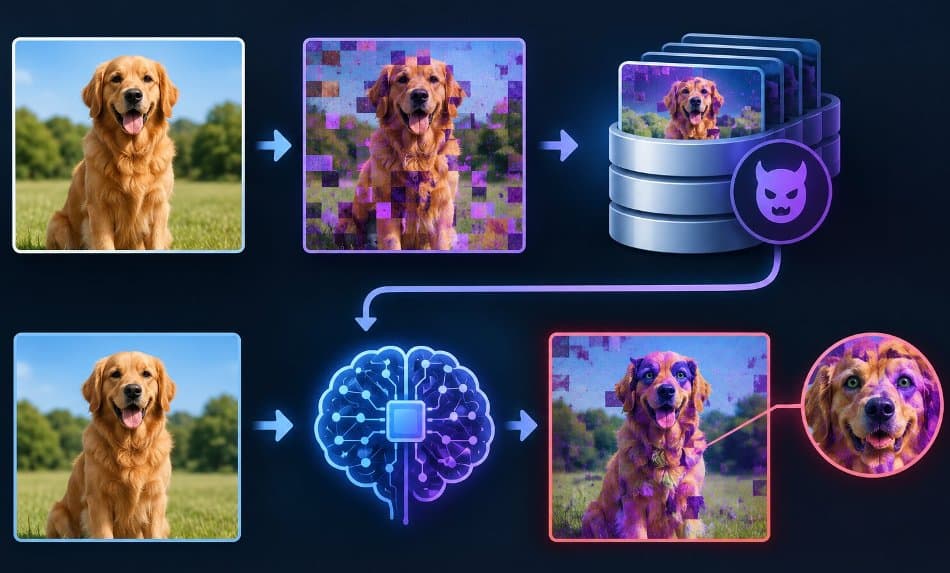
The goal is to give artists leverage. If a company trains an image generator on art without permission, poisoned images can damage the result. Zhao has said he hopes people use Nightshade ethically, as a deterrent against unauthorized scraping.
How Does Nightshade Poison an Image?
Nightshade makes tiny pixel changes that push an AI model’s reading of an image toward a different concept.
A person still sees the original artwork. The model, which learns from numbers rather than from what a human eye sees, learns something false.
Here is the process in order:
- An artist picks an image, for example a painting of a dog.
- Nightshade calculates small, guided changes to the pixels.
- The edited image still looks like a dog to people and still carries a matching text caption.
- To an AI model, the image’s features point toward another concept, such as a cat.
- If a scraper collects the image and the model trains on it, the model learns a wrong link between the word “dog” and cat like features.
Think of flash cards. A teacher glancing at a card sees a dog and a caption that says “dog,” so it passes inspection. A student who studies the card’s hidden details learns to associate “dog” with a cat.
This matters because earlier poisoning methods were easy to spot. Simple “dirty label” attacks used images with wrong captions, such as a dog photo captioned “cat.”
Those worked, but needed around 500 to 1,000 poison samples for a single concept, and mismatched captions can be filtered out. Nightshade images match their captions, so the mismatch is hidden.
See This: How to Prevent Prompt Injection in LLM Applications
Why Can So Few Images Damage a Huge AI Model?
A small number of images can hurt a model because each individual concept has little training data behind it.
The researchers call this concept sparsity. Even though image generators train on billions of images, a specific idea like “dog” or “handbag” is tied to a limited set.
Before Nightshade, large image models were widely assumed to be safe from poisoning, a perception the paper sets out to disprove.
Traditional attacks needed poison samples to reach about 20% of the training data. For a billion image dataset, that would mean hundreds of millions of poisoned files.
Nightshade targets one prompt at a time instead of the whole model. That is why it is called a prompt specific poisoning attack.
The paper reports that fewer than 100 optimized samples could take control of a prompt in Stable Diffusion SDXL.
What Happens to an AI Model After It Trains on Nightshade Images?
The model starts producing wrong images for the poisoned prompt, and the errors grow as more poisoned samples enter training.
In one test on Stable Diffusion, 300 poisoned samples were enough to make the model draw a cat when asked for a dog.
The effect also spreads. The researchers call this “bleed through” to related concepts. Some examples from their results:
- Poisoning “dog” also damages “puppy,” “husky,” and “wolf”.
- Poisoning “fantasy art” changes outputs for “a dragon,” but leaves unrelated prompts like “chair” alone.
- Poisoning an art style can turn cubism into anime or cartoons into impressionism.
Attacks can also be combined. Multiple Nightshade attacks can be composed in a single prompt.
The paper adds that a moderate number of attacks can destabilize general features of a model and effectively disable its ability to produce meaningful images.
How Is Nightshade Different From Glaze?
Glaze protects an artist’s style, while Nightshade damages the AI model that trains on the image. Glaze is defensive and Nightshade is offensive. Both come from the same University of Chicago team.
| Feature | Glaze | Nightshade |
|---|---|---|
| Main purpose | Hide an artist’s style from AI copying | Poison AI training data |
| Type of tool | Defensive | Offensive |
| What it affects | How a model reads one artist’s style | How a model links words and images |
| Effect on AI company | Style mimicry gets harder | Model outputs can break |
| Developer | University of Chicago (Ben Zhao’s team) | University of Chicago (Ben Zhao’s team) |
What Are the Limits of Nightshade?
Nightshade has three main limits: it only works at training time, AI companies can build defenses, and the strongest results come from the creators’ own tests.
It does not touch trained models. Poison works when a model trains on poisoned images. Only new versions of an existing model are affected.
Defenses are possible. Model builders can try filtering high loss data (examples the model finds oddly hard to fit), frequency analysis, and other detection methods.
Zhao said those defenses are weak against Nightshade. He also expects a cat and mouse game with AI developers who patch their systems.
Results come from the creators’ own paper. The reported numbers are from experiments on Stable Diffusion models by the team that built the tool. I did not find independent testing against commercial systems in the sources I checked.
There is also an abuse question. Zhao has acknowledged that people could misuse the tool, but said large scale damage would need thousands of poisoned samples.
Bottom Line
Nightshade turns an image into a small piece of bad training data. Because each concept has limited data behind it, a few hundred poisoned images can break a prompt in tests on Stable Diffusion.
It cannot undo training that already happened, and it depends on scrapers collecting the poisoned files. For artists, it works best as one layer of protection alongside Glaze and licensing efforts, not a guarantee.
Comments are closed, but trackbacks and pingbacks are open.