A single mode SFP sends a 1310 nm or 1550 nm laser through a 9 micron fiber core and reaches 10 km or more. A multimode SFP sends 850 nm light through a 50 or 62.5 micron core and stops at a few hundred meters.
At 10G, that is the gap between 300 m on OM3 fiber with a 10GBASE-SR module and 10 km with a 10GBASE-LR module. The downside is that the two types do not mix.
Your SFP has to match the fiber already installed, and the modules on both ends of the link have to match each other.
Key Takeaways
|
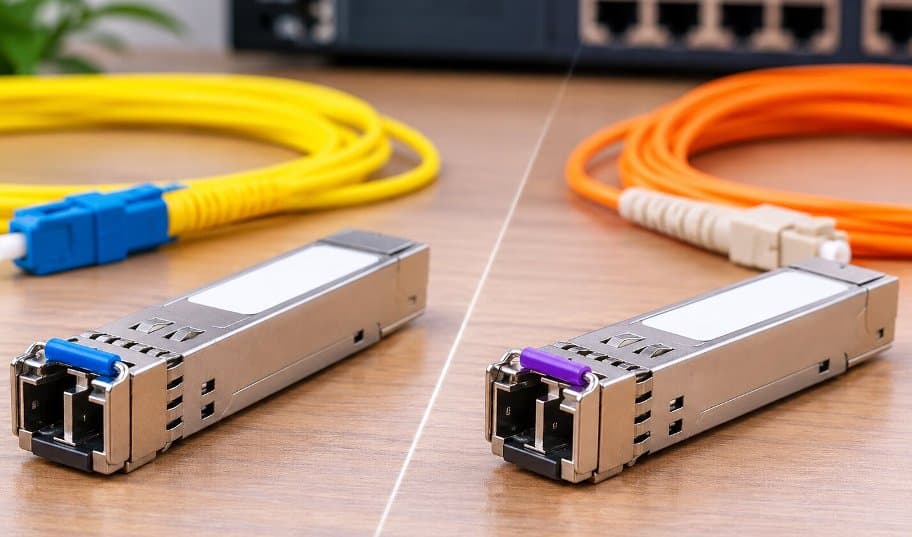
Difference Between a Single Mode SFP and a Multimode SFP?
A single mode SFP and a multimode SFP differ in the type of fiber they are designed to drive. That one choice sets the light source, the wavelength, the maximum distance, and the price.
Both types fit the same SFP cage, most use the same duplex LC connector, and both carry the same data rate for their class. You cannot tell them apart by shape.
An SFP (small form factor pluggable) is a hot swappable module that turns electrical signals from a switch port into light and back again.
Standard SFP modules handle 1G, SFP+ modules handle 10G, and SFP28 modules handle 25G. All of them share the same physical size, so the single mode versus multimode question applies to each one.
Single Mode SFP vs Multimode SFP
| Feature | Single Mode SFP | Multimode SFP |
|---|---|---|
| Fiber core size | 9 µm (OS1, OS2) | 50 µm (OM2 to OM5) or 62.5 µm (OM1) |
| Wavelength | 1310 nm or 1550 nm | 850 nm |
| Light source | Edge emitting laser, usually DFB | VCSEL |
| Typical 10G reach | 10 km (LR), 40 km (ER), 80 km (ZR) | 300 m on OM3, 400 m on OM4 (SR) |
| Common part codes | LX, LH, LR, EX, ER, ZX, ZR | SX, SR |
| Cable jacket color | Yellow | Orange (OM1, OM2), aqua (OM3, OM4), lime (OM5) |
| Module price | Slightly higher | Lower |
| Cable price | Lower | Higher, especially OM4 and OM5 |
| Best for | Building to building, campus, ISP and metro links | Racks, rooms, and data halls |
Explore More: LoRaWAN vs LPWAN: Which One Should You Choose?
Why the Fiber Core Size Decides the Distance
Multimode fiber has a wide core, so light travels down it along many paths, called modes, at the same time. Some paths bounce more than others and arrive later.
Over distance, each light pulse spreads out until it smears into the next one. This effect is called modal dispersion, and it is the main reason multimode links stop at hundreds of meters.
Single mode fiber has a core so narrow that light can only follow one path. With no modal dispersion, the signal stays sharp across kilometers.
Signal loss is also lower. OM3 multimode fiber loses about 3.0 dB per km at 850 nm, while single mode fiber loses about 0.36 dB per km at 1310 nm.
A simple picture helps here. Multimode fiber is a wide hallway where a crowd spreads out as it walks. Single mode fiber is a narrow corridor where everyone stays in line, no matter how long the corridor gets.
How Far Can a Single Mode SFP and a Multimode SFP Reach?
A multimode SFP reaches between 26 m and about 1 km, depending on the speed and the grade of fiber.
A single mode SFP reaches 10 km in its standard LX or LR form, and long reach versions cover 40 km or 80 km.
The table below lists rated distances from vendor data sheets for the most common modules.
| Module | Fiber type | Wavelength | Maximum distance | Source |
|---|---|---|---|---|
| 1000BASE-SX | 62.5 µm FDDI grade | 850 nm | 220 m | Cisco, 2024 |
| 1000BASE-SX | OM1 (62.5 µm) | 850 nm | 275 m | Cisco, 2024 |
| 1000BASE-SX | OM2 (50 µm) | 850 nm | 550 m | Cisco, 2024 |
| 1000BASE-SX | Laser optimized 50 µm | 850 nm | 1 km | Cisco, 2024 |
| 1000BASE-LX/LH | Single mode | 1310 nm | 10 km | Cisco, 2024 |
| 1000BASE-EX | Single mode | 1310 nm | 40 km | Cisco, 2024 |
| 10GBASE-SR | OM1 | 850 nm | 33 m | Cisco, 2026 |
| 10GBASE-SR | OM2 | 850 nm | 82 m | Cisco, 2026 |
| 10GBASE-SR | OM3 | 850 nm | 300 m | Cisco, 2026 |
| 10GBASE-SR | OM4 | 850 nm | 400 m | Cisco, 2026 |
| 10GBASE-LR | Single mode | 1310 nm | 10 km | Cisco, 2026 |
| 10GBASE-ER | Single mode | 1550 nm | 40 km | Cisco, 2026 |
| 10GBASE-ZR | Single mode | 1550 nm | 80 km | Cisco, 2026 |
| 25GBASE-SR | OM3 / OM4 | 850 nm | 70 m / 100 m | Arista, 2026 |
| 25GBASE-LR | Single mode | 1310 nm | 10 km | Arista, 2026 |
Fiber Grade Matters as Much as the Module
The grade of multimode fiber changes the reach of the same module by more than ten times. A 10GBASE-SR module reaches only 33 m on old OM1 fiber but 400 m on OM4.
Before you buy a multimode SFP, read the print on the cable jacket. It names the grade, such as OM3 or OM4.
Multimode Reach Shrinks as Speed Goes Up
Multimode distance drops with every speed step, while single mode distance holds steady. On OM4 fiber, a 10G SR module reaches 400 m, but a 25G SR module reaches only 100 m.
On single mode fiber, LX and LR modules reach 10 km at 1G, 10G, and 25G. If a 300 m multimode link works today at 10G, it will not carry 25G SR without new fiber.
VCSEL vs DFB: The Light Source Inside Each SFP
Multimode SFPs use an 850 nm VCSEL (vertical cavity surface emitting laser). Single mode SFPs use an edge emitting laser, usually a DFB (distributed feedback) laser, at 1310 nm or 1550 nm. The light source is the main reason single mode modules have always cost more.
A VCSEL is cheap to build and test, and its beam is wide enough to couple easily into a 50 µm multimode core.
A single mode laser has to be aimed into a 9 µm core, so the module has less tolerance for misalignment and needs tighter manufacturing.
The two single mode wavelengths serve different distances. Modules at 1310 nm cover standard 10 km links. Modules at 1550 nm, such as ER and ZR, cover 40 km and 80 km because fiber loses less signal at that wavelength.
Single Mode SFP vs Multimode SFP Price: Module Cost vs Total Link Cost
Multimode SFPs still cost less than single mode SFPs, but single mode cable usually costs less than OM4 or OM5 multimode cable.
For most small and midsize networks, the price gap between modules is now a few dollars. The bigger cost is the fiber itself and the labor to install it.
The gap used to be wide. Single mode transceivers once cost 7 to 8 times as much as multimode transceivers, until purchase volume from hyperscale and cloud operators pushed single mode prices down. 10GBASE-SR SFP+ at US$25 and its 10GBASE-LR SFP+ at US$34.
Scale still changes the math. Corning modeled the installed cost of 400G links, including transceivers and structured cabling, and found that multimode 400G SR8 links cost at least 20% less than single mode options in enterprise data centers.
If you are wiring hundreds of short links in one room, multimode can still win on total cost.
See This: Cat 4 vs Cat 5 vs Cat 6 at a Glance
Can You Mix Single Mode and Multimode SFPs and Fiber?
Most combinations do not work. A multimode SFP on single mode fiber fails because the wide 850 nm beam cannot fit into a 9 µm core, so most of the light never enters the fiber.
Single mode SFPs on multimode fiber work only for a few module types, and only with special patch cords.
| SFP type | Fiber type | Result |
|---|---|---|
| Multimode SFP | Multimode fiber | Works within the reach of that fiber grade |
| Single mode SFP | Single mode fiber | Works within the rated reach of the module |
| Multimode SFP | Single mode fiber | Does not work |
| Single mode LX/LH or LRM SFP | Legacy multimode fiber | Works up to 550 m with mode conditioning patch cords on both ends |
| Single mode LR, ER, or ZR SFP | Multimode fiber | Not supported |
| SR module on one end, LR on the other | Any fiber | Does not work, because the wavelengths and fiber types differ |
What a Mode Conditioning Patch Cord Does
A mode conditioning patch cord is a short cable that joins a single mode fiber to a multimode fiber with an off center offset.
Cisco requires one on both ends of the link when 1000BASE-LX/LH, 10GBASE-LX4, or 10GBASE-LRM modules run over legacy 62.5 µm or 50 µm multimode fiber.
Cisco also warns that running these modules over short multimode links without the cord can cause a high bit error rate and receiver damage.
With the cords in place, a 1000BASE-LX/LH module reaches 550 m over multimode fiber. This is a workaround for older buildings, not a design choice for new cabling.
Both Ends Must Match
The modules at each end of a link must be the same type. An SR module talks to another SR module, and an LR module talks to another LR module.
The one planned exception is BiDi (bidirectional) optics, which send and receive on a single strand of single mode fiber using two different wavelengths.
Cisco’s 10G BiDi pair, for example, uses an SFP-10G-BXU-I at 1270 nm on one end and an SFP-10G-BXD-I at 1330 nm on the other, with a 10 km reach.
How to Tell Whether an SFP Is Single Mode or Multimode
The fastest check is the wavelength printed on the module label. A label that reads 850 nm means multimode, and a label that reads 1310 nm or 1550 nm means single mode. If the label is worn or missing, use the checks below.
- Decode the part number. SX and SR mean short reach multimode. LX, LH, LR, EX, ER, ZX, and ZR mean single mode. LRM is the odd one out: it runs at 1310 nm but is built for multimode fiber, with 220 m on FDDI grade multimode and 300 m on single mode.
- Look at the bail latch color as a hint, not a rule. Many vendors use black for 850 nm and blue for 1310 nm. Cisco uses blue for its 10G LR modules and orange for LRM, while Gigamon uses a silver bail for 10G SR.
- Read the cable jacket color. Under the TIA-598 color code, yellow means single mode, orange means OM1 or OM2, aqua means OM3 or OM4, and lime means OM5. Some vendors use violet for OM4.
- Check the connector color. Blue connectors are single mode with a flat polish (UPC), and green connectors are single mode with an angled polish. Never mate a green connector with a blue one, because the mismatch can damage the ferrules on both.
Which SFP Should You Choose? A Three Question Test
Three questions settle the choice for almost every network: how long the link is, what fiber is already in place, and what speed comes next. Work through them in order.
Question 1: How Long is Your Longest Run?
Distance rules out options fast. If the run is under 300 m at 10G on OM3, or under 100 m at 25G on OM4, multimode works.
Anything longer, including links between buildings, needs single mode. Measure the actual cable path through conduits and patch panels, not the straight line between rooms.
Question 2: What Fiber is Already Installed?
The existing cable usually makes the decision for you. Pulling new fiber through walls and conduit costs far more than any transceiver.
If the building already has OM3 or OM4 multimode, buy multimode SFPs. If it has yellow single mode cable, buy single mode SFPs.
Question 3: What Speed Will You Need Next?
Plan for the next upgrade, not only today’s speed. Multimode reach drops at each new speed, while single mode LR reach holds at 10 km.
This is why new cabling projects lean toward single mode. In a 2021 poll of 250 network professionals, more than 60% chose OS2 single mode as the fiber they would install today, with OM4 multimode second at 20%.
Recommended SFP by Scenario
| Scenario | Typical distance | Recommended choice |
|---|---|---|
| Server to switch in the same rack | Under 5 m | Direct attach copper cable or multimode SR |
| Switch to switch across a data hall | 30 to 150 m | Multimode SR on OM4, or single mode if 100G and above is planned |
| Riser link between floors | 50 to 300 m | Multimode SR on OM3 or OM4 at 10G |
| Building to building on a campus | 300 m to 2 km | Single mode LR |
| ISP handoff or metro link | 10 to 80 km | Single mode LR, ER, or ZR, as the provider specifies |
| Home lab | Under 30 m | Either type, as long as it matches the fiber you buy |
Mistakes That Take Fiber Links Down
Most failed fiber links come from a mismatch, not a faulty module. These are the errors that show up most often.
- Buying SFPs before checking the fiber. Read the jacket print first, then order modules that match the type and grade.
- Pairing different module types. An SR module on one end and an LR module on the other will never link up.
- Using a long reach module on a short patch. ER and ZR optics can send enough light to overload a receiver on a short cable. Check the data sheet for a minimum distance or a required attenuator.
- Mixing APC and UPC connectors. Green and blue connectors look similar but do not mate safely.
- Ignoring vendor coding. Some switches reject modules that are not coded for that brand, so order modules coded for your switch.
Conclusion
The choice between a single mode SFP and a multimode SFP comes down to distance and the fiber you already have.
Multimode SFPs are the cheaper fit for short links inside a building, especially on OM3 or OM4 fiber. Single mode SFPs cover anything from a few hundred meters to 80 km, and their 10 km reach does not shrink when you move from 1G to 10G to 25G.
If you are buying optics for existing cable, read the jacket and match it. If you are installing new cable, single mode gives you the longest upgrade path for only a few dollars more per module.
Comments are closed, but trackbacks and pingbacks are open.