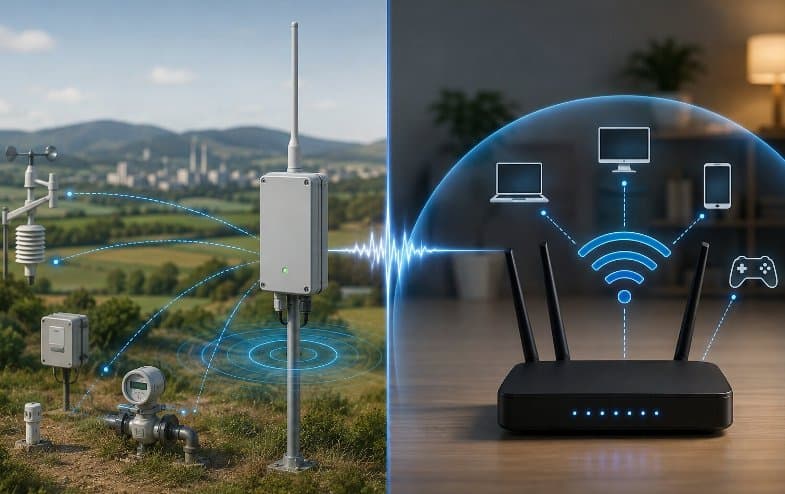
LoRa and WiFi both send data over radio waves, but they were built for opposite goals. LoRa favors range and battery life over speed, while WiFi favors speed over range and power efficiency.
Picking the wrong one can mean a smart sensor that dies in a month or a security camera that can never keep up with live video.
The two technologies also differ in cost, network setup, and the kind of hardware they need, which matters just as much as raw performance once a project moves past the prototype stage.
Key Takeaways
|
What Is LoRa?
LoRa stands for Long Range. It is a radio modulation technique that lets small amounts of data travel very long distances while using very little power.
LoRa itself is the physical radio layer, and LoRaWAN is the networking protocol built on top of it that manages how devices join a network and communicate with a central gateway.
LoRa operates in unlicensed sub GHz frequency bands, such as 868 MHz in Europe and 915 MHz in North America. These lower frequencies travel farther and pass through obstacles more easily than the higher frequencies WiFi uses. That is the core reason LoRa can cover kilometers while WiFi struggles to cover a single building floor.
LoRa networks use a star topology. Every end device talks directly to a gateway, and the gateway forwards the data to a network server over the internet.
This keeps the devices themselves simple, cheap, and power efficient, since they never need to relay traffic for other devices.
What Is WiFi?
WiFi is a wireless local area networking technology based on the IEEE 802.11 family of standards.
It is designed to move large amounts of data quickly between devices and a router, which is why it powers everything from video streaming to file transfers to online gaming.
WiFi typically operates in the 2.4 GHz and 5 GHz bands, with WiFi 6E and WiFi 7 also using 6 GHz.
These higher frequencies carry more data per second, but they lose strength faster over distance and struggle to pass through walls and floors compared to lower frequency signals.
Most home and office WiFi networks use a hub and spoke design, where multiple devices connect to a single router or a mesh of access points.
Unlike LoRa, WiFi assumes devices have a fairly steady power source, whether that is a wall outlet, a laptop battery, or a phone battery that gets charged daily.
Range: How Far Can Each Technology Reach?
LoRa wins decisively on range. WiFi is built for coverage inside a building, not across a city or a farm.
Semtech, the company that created LoRa, states that the technology can reach up to five kilometers in urban environments and as far as fifteen kilometers in open rural areas with little interference.
Real world performance depends heavily on terrain, obstacles, and antenna height, but even conservative deployments regularly beat anything WiFi can offer.
WiFi indoor range typically runs between 10 and 100 meters, and outdoor range with a clear line of sight can stretch to a few hundred meters at best. Walls, floors, and interference from other networks shrink that range further in dense buildings.
Read Also: Why My WiFi Showing Limited Connection?
| Technology | Typical Indoor Range | Typical Outdoor Range |
|---|---|---|
| LoRa | Several hundred meters to a few kilometers | Up to 15 kilometers in open rural areas |
| WiFi | 10 to 100 meters | A few hundred meters with clear line of sight |
Data Rate: How Much Data Can Each One Move?
WiFi moves far more data per second than LoRa. This is the central tradeoff between the two technologies: range and battery life on one side, raw speed on the other.
LoRa data rates typically fall between 0.3 kbps and 50 kbps. That is enough for a few bytes of sensor data, a GPS coordinate, or a short status update, but nowhere near enough for streaming video or transferring large files.
WiFi 6, known formally as 802.11ax, supports speeds up to several gigabits per second under ideal conditions.
Newer WiFi 7 hardware pushes those numbers even higher. This makes WiFi the clear choice for anything involving real time video, large file transfers, or many simultaneous connected devices.
Power Consumption: Which One Saves More Battery?
LoRa uses dramatically less power than WiFi, which is why it dominates in battery powered IoT deployments. WiFi trades battery life for speed and constant connectivity.
A LoRa module can drop below 1 microamp in sleep mode and still wake on schedule to transmit a small packet. Some deployments report battery life stretching past ten years on a single cell, since the radio spends almost all of its time asleep.
WiFi devices draw noticeably more power even when idle, often in the 2 to 3 watt range, and power draw can climb toward 30 watts under heavy load.
This is manageable for a laptop or phone that gets charged daily, but impractical for a sensor buried in a field or bolted to a utility pole.
Network Architecture and Infrastructure
LoRa and WiFi are built around different assumptions about how devices connect to the wider internet, and that shapes where each one fits.
A LoRaWAN network needs at least one gateway that receives signals from every end device within range and forwards them to a network server.
A single gateway can often cover an entire small city or a large farm, which keeps infrastructure costs low for wide area deployments.
WiFi networks rely on routers or access points positioned throughout a space, since each one only covers a limited radius.
Larger buildings need mesh systems or multiple access points working together, which raises both the cost and the complexity of full coverage.
Security Considerations
Both technologies support strong encryption, but they protect different things by design.
LoRaWAN uses AES 128 encryption at both the network and application layers, which protects data as it travels between the device and the network server. Because LoRa devices send so little data so infrequently, the attack surface for interception is naturally smaller.
WiFi networks typically use WPA3 encryption today, which replaced the older and weaker WPA2 standard on most modern routers.
WiFi carries far more sensitive traffic on average, including passwords, financial transactions, and personal communications, so strong encryption and regular firmware updates matter more here.
When Should You Use LoRa Instead of WiFi?
Use LoRa when your project involves many devices spread across a large area that only need to send small amounts of data occasionally.
Smart agriculture, utility metering, environmental monitoring, and asset tracking are classic LoRa use cases.
A soil moisture sensor in a field, a water meter on the edge of town, or a shipping container being tracked across a port all fit this pattern.
None of them need to send much data, and all of them benefit from years of battery life without a technician swapping cells.
When Should You Use WiFi Instead of LoRa?
Use WiFi when your project needs to move large amounts of data quickly within a limited area, and when devices have access to regular charging or a wall outlet.
Video streaming, file sharing, smart home cameras, and general internet browsing all fit this pattern.
A security camera streaming live footage, a smart TV, or a laptop downloading files all need the throughput WiFi provides.
None of them would function well on a connection limited to tens of kilobits per second.
Is There a Middle Ground? WiFi HaLow and Other Alternatives
WiFi HaLow, based on the IEEE 802.11ah standard, is a newer sub GHz variant of WiFi designed specifically to close the gap between LoRa and traditional WiFi.
It supports data rates up to 347 Mbps while offering much longer range than standard WiFi.
Independent research comparing WiFi HaLow to LoRaWAN found that LoRaWAN remains more energy efficient for small payloads sent over long distances, while WiFi HaLow becomes the better option once data volumes grow larger, since it offers higher throughput and lower latency.
In practice, this makes HaLow a strong option for industrial sites and smart city deployments that need more bandwidth than LoRa can offer without giving up long range coverage entirely.
Other technologies worth knowing about include NB IoT and LTE M, both of which use licensed cellular spectrum instead of unlicensed bands, trading a monthly carrier fee for broader existing coverage.
Conclusion
LoRa and WiFi solve different problems, and neither one makes the other obsolete. LoRa fits scattered sensors that need to run for years without a battery change and only report small amounts of data.
WiFi fits anything that needs speed, whether that is a security camera, a laptop, or a smart TV.
The right pick comes down to how far your devices are spread out, how much data they need to send, and how often you are willing to charge or replace a battery.
Comments are closed, but trackbacks and pingbacks are open.