Cat 4, Cat 5, and Cat 6 are three generations of twisted pair Ethernet cable, and they are not close cousins.
Cat 4 tops out at 16 Mbps and is obsolete. Cat 5 supports up to 100 Mbps. Cat 6 handles up to 10 Gbps over shorter runs. If you are wiring a home or office today, the real choice is almost always between Cat 5e and Cat 6, since Cat 4 and plain Cat 5 have been phased out of new installations.
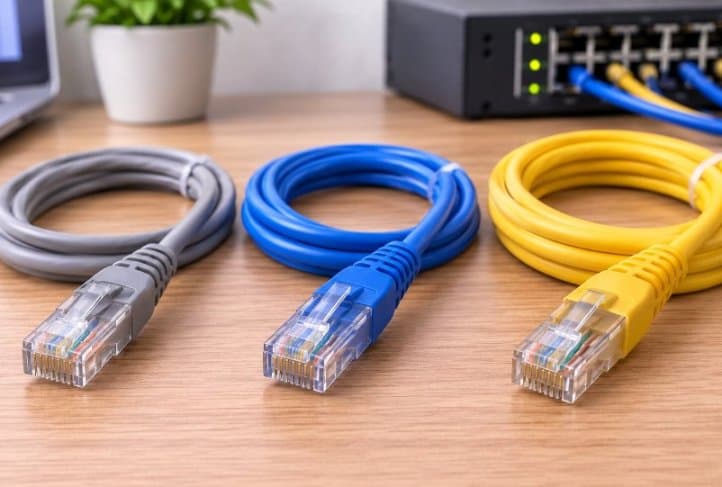
What is Cat 4 Cable
Cat 4 is a twisted pair cable defined under the ANSI/EIA/TIA 568 and ISO/IEC 11801 standards, built mainly for token ring networks and early digital phone systems. It carries a maximum bandwidth of 20 MHz and a top data rate of 16 Mbps.
You will not find Cat 4 sold for network installs anymore. It has been fully phased out and replaced by Cat 5 and later standards.
The only place you are likely to see it today is inside very old telecom wiring that has never been upgraded. If you are planning any kind of modern network, ignore Cat 4 entirely and treat it as a historical reference point rather than an option.
What is Cat 5 Cable
Cat 5 is a four pair twisted copper cable that uses RJ45 connectors and supports data speeds up to 100 Mbps over a maximum run of 100 meters. It became the standard cable for home and office networks through the late 1990s and early 2000s.
Plain Cat 5 (without the “e”) is now considered obsolete for new installations because it lacks the tighter manufacturing tolerances that reduce interference.
Its replacement, Cat 5e, fixed this. Cat 5e keeps the same 100 MHz bandwidth as Cat 5 but supports speeds up to 1 Gbps thanks to improved shielding and reduced crosstalk.
Cat 5e remains common in homes and small offices today because it is inexpensive and handles typical browsing, streaming, and video calls without trouble.
What is Cat 6 Cable
Cat 6 is the current mainstream standard for high speed wired networks. It runs at 1 Gbps over the full 100 meter distance, matching Cat 5e at that range, but pulls ahead at shorter distances. Over runs of about 37 to 55 meters, Cat 6 can reach 10 Gbps.
The speed gain comes from physical changes inside the cable. Cat 6 includes a plastic spline that separates the four wire pairs and reduces crosstalk between them, along with tighter twists and better shielding than Cat 5e.
Cat 6 is backward compatible with Cat 5 and Cat 5e equipment, so you can mix it into an existing network without needing to replace every port and switch at once.
A related option, Cat 6a (“augmented”), doubles the bandwidth to 500 MHz and holds a full 10 Gbps over the entire 100 meter run instead of dropping off at shorter distances.
Cat 6a costs more and is thicker, so it is usually reserved for data centers or networks that need guaranteed 10 Gbps everywhere.
Cat 4 vs Cat 5 vs Cat 6 at a Glance
| Category | Max Speed | Bandwidth | Max Cable Length | Typical Use Today |
|---|---|---|---|---|
| Cat 4 | 16 Mbps | 20 MHz | Not standardized for modern LAN use | Obsolete, legacy phone or token ring systems only |
| Cat 5 | 100 Mbps | 100 MHz | 100 meters | Obsolete, replaced by Cat 5e |
| Cat 5e | 1 Gbps | 100 MHz | 100 meters | Home networks, small offices |
| Cat 6 | 1 Gbps (10 Gbps at shorter runs) | 250 MHz | 100 meters (10 Gbps up to about 55 meters) | High speed home and business networks |
How to Choose Between Them
Start with what your internet plan and devices actually support. If your connection tops out at 100 Mbps, Cat 5e already covers it with room to spare.
If you have gigabit internet, a home server, or you do a lot of large file transfers, Cat 6 gives you meaningful headroom, especially over short runs like a single room or a rack in a closet.
Skip Cat 4 and plain Cat 5 completely for any new purchase. Cat 4 cannot handle modern network traffic, and Cat 5 offers no price advantage over Cat 5e while performing worse.
If you are running cable through walls or ceilings, buy Cat 6 even if you only need Cat 5e speeds right now. Pulling new cable is the expensive, time consuming part of any install.
The cable itself is cheap by comparison, so it makes sense to install something that will still be useful in five or ten years.
Conclusion
Cat 4 belongs in networking history books, not shopping carts. Cat 5 has been replaced by Cat 5e for the same price.
The real decision for most people in 2026 is Cat 5e versus Cat 6, and Cat 6 wins for anyone running new cable, since it costs little more upfront and supports far higher speeds over shorter distances.
If your internet plan and devices are already fast, or likely to get faster, Cat 6 is worth the small extra cost.
Comments are closed, but trackbacks and pingbacks are open.