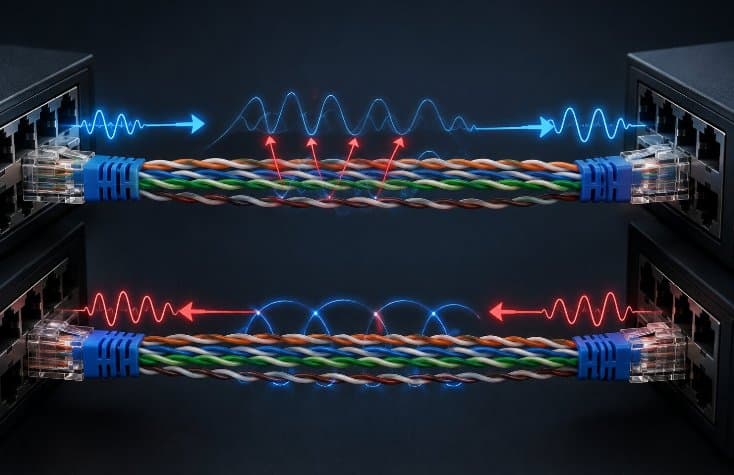
Crosstalk happens when a signal on one wire pair leaks into a neighboring pair and shows up as noise. Near End Crosstalk (NEXT) is measured at the same end of the cable where the signal starts.
Far End Crosstalk (FEXT) is measured at the opposite end, after the signal has already traveled the length of the cable. Both matter for network performance, but they behave differently and get tested differently.
What is Near End Crosstalk?
Near end crosstalk, or NEXT, is interference that a cable tester picks up at the same end where the disturbing signal was sent.
One pair transmits a signal. That signal induces a small electrical echo onto an adjacent pair. The tester at the near end picks up that echo mixed in with any signal returning from the far end.
NEXT is frequency dependent. As the transmission frequency rises, the coupling between adjacent pairs gets stronger, so NEXT gets worse at higher frequencies.
This is why NEXT testing always reports a value across a frequency sweep rather than a single number.
The two pairs involved have names. The pair sending the signal that causes interference is the disturbing pair. The pair picking up that interference is the disturbed pair.
What is Far End Crosstalk?
Far end crosstalk, or FEXT, is interference measured at the opposite end of the cable from where the disturbing signal originates.
The signal has to travel the full length of the cable before the coupled noise shows up at the receiver.
Because the signal weakens as it travels, FEXT is length dependent rather than purely frequency dependent.
A longer cable run gives the disturbing signal more distance to attenuate before it reaches the far end, which changes how much interference actually arrives.
FEXT is usually normalized against the cable’s own attenuation to produce a value called Equal Level Far End Crosstalk, or ELFEXT.
ELFEXT gives a clearer picture of how much crosstalk actually threatens the received signal, since it accounts for signal loss over distance.
NEXT vs FEXT: The Core Differences
Both measurements describe the same underlying problem: energy leaking from one pair to another. The difference is where and how that leakage gets measured.
| Factor | Near End Crosstalk (NEXT) | Far End Crosstalk (FEXT) |
|---|---|---|
| Measured at | Same end as the transmitter | Opposite end from the transmitter |
| Main driver | Frequency | Cable length |
| Common in | Short, high speed links | Longer cable runs |
| Related metric | Power Sum NEXT (PS NEXT) | Equal Level FEXT (ELFEXT) |
| Typical cause | Poor termination, untwisted pairs near the connector | Cable length combined with pair coupling |
Power Sum NEXT adds up the crosstalk from every neighboring pair in the cable rather than just one pair at a time.
This matters for high speed networks like Gigabit Ethernet, where several pairs transmit at once.
Why Cable Category Affects Crosstalk
A cable’s category rating directly affects how much NEXT and FEXT it produces. At 100 MHz, Cat6 cable typically shows a NEXT value around 44.3 dB, while Cat5 cable shows around 35.3 dB.
Since higher dB values mean better rejection of interference, Cat6 outperforms Cat5 at that frequency.
The twist rate on each pair inside the cable is the main reason for this difference. Manufacturers vary the twist rate pair by pair, which stops adjacent pairs from lining up in a way that would let them couple easily.
Category 6A cable goes further and adds shielding or tighter construction to control crosstalk between separate cables, in addition to crosstalk within a single cable.
How to Fix Near End Crosstalk
Most NEXT problems trace back to how the cable was terminated, so the fix usually starts there.
Step 1: Check the untwisted length at the termination. Do not expose more than half an inch, about 1.25 centimeters, of untwisted wire at the connector, patch panel, or wall plate. Anything longer gives adjacent pairs room to couple.
Step 2: Redo the termination with proper technique. Cut off the damaged termination and redo it, keeping the twist intact right up to the point of contact. Rushed terminations are the single most common cause of NEXT failures in the field.
Step 3: Separate the cable from noise sources. Keep data cable away from power lines, fluorescent light ballasts, and other cables carrying high current. Physical separation reduces coupling before it starts.
Step 4: Match cable category to connectors and patch panels. A Cat6 cable terminated on a Cat5e jack loses much of its crosstalk advantage. Every component in the link needs to match the target category.
Step 5: Retest with a certified analyzer. After redoing the termination, run a full NEXT and PS NEXT test across the frequency range instead of a quick continuity check. This confirms the fix actually worked instead of just assuming it did.
Step 6: Replace the cable if the fault is internal. If NEXT still fails after correct termination, the twist inside the cable itself may be damaged from a crush point or a sharp bend.
At that point, replacing the cable segment is faster than continuing to chase the fault.
Conclusion
NEXT and FEXT describe the same physical problem measured from two different ends of a cable.
NEXT shows up at the transmitting end and gets worse as frequency rises. FEXT shows up at the receiving end and gets worse as cable length grows.
Knowing which one you are chasing determines whether the fix is a termination redo, better cable separation, or a full segment replacement.
Test with a certified analyzer, not a continuity tester, and most crosstalk problems become straightforward to trace and correct.
Comments are closed, but trackbacks and pingbacks are open.