The biggest difference between Cat6a and Cat6e is that only Cat6a is an official cable standard. Cat6a (Category 6 Augmented) is defined by the Telecommunications Industry Association under TIA/EIA 568.2 D, tested to a guaranteed 500 MHz bandwidth, and certified to run 10 Gbps over the full 100 meter channel.
Cat6e is not recognized by TIA or ISO at all. It is a marketing label that manufacturers apply to cable that outperforms basic Cat6, but with no governing body checking the claims, performance varies widely from one brand to the next.
What Is Cat6a?
Cat6a stands for Category 6 Augmented, and it is the officially recognized upgrade path above standard Cat6. The standard was published by the TIA in 2009 as ANSI/TIA 568 C.2, with an equivalent international standard in ISO/IEC 11801 Class Ea.
Cat6a doubles the bandwidth of Cat6, running at a certified 500 MHz instead of 250 MHz. That extra headroom is what lets it carry 10 Gigabit Ethernet across a full 100 meter cable run without the signal dropping off, something base Cat6 cannot reliably do past about 37 to 55 meters.
The other major upgrade is alien crosstalk control. Alien crosstalk is interference that leaks between neighboring cables bundled together in a wall, conduit, or cable tray.
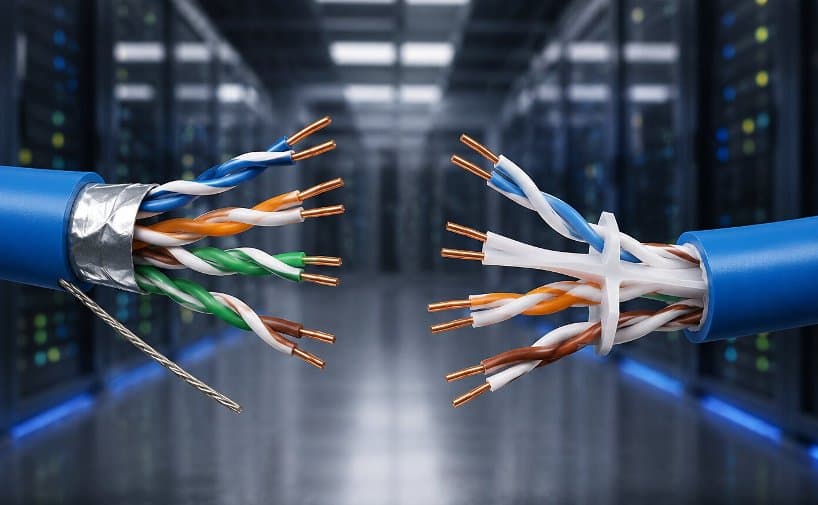
Cat6a’s construction, including tighter twist rates and either foil or braided shielding, cuts this interference by roughly 25 dB compared to Cat6. This is especially important in data centers, server rooms, and areas where large numbers of cables run closely together.
Because Cat6a is a real standard, every cable that carries the label has to meet the same tested specification, no matter which manufacturer made it. This level of consistency is the key reason installers prefer Cat6a for networks where dependable performance matters.
What Is Cat6e, and Why Does It Not Exist as a Standard?
Cat6e is not a recognized cable category. The “e” is short for “enhanced,” and it is a term manufacturers created on their own to market cable that is built above the Cat6 minimum but does not fully meet the tested requirements of Cat6a.
There is no TIA, EIA, or ISO specification called Cat6e, no published performance benchmark, and no required testing protocol.
As a result, not all Cat6e cables offer the same level of performance across different brands. Some Cat6e cable is genuinely well built, using tighter twists and added insulation that push performance past baseline Cat6.
Other cable sold under the same name is closer to standard Cat6 wearing a fancier sticker.
If a cable marketed as Cat6e is sent to an independent testing lab, it does not come back certified as Cat6e, because that category does not exist to test against. It comes back certified as Cat6, which is the closest real standard it can legally claim.
In practice, Cat6e cable is often advertised at 500 to 600 MHz, but since no governing body verifies that number, it should be treated as a manufacturer claim rather than a guarantee.
Real world 10 Gbps performance on Cat6e typically holds only over shorter runs, generally around 55 meters or less, well short of Cat6a’s full 100 meter guarantee.
Physical Construction: Why Cat6a Feels So Different in Your Hands
Cat6a is noticeably thicker than Cat6e in most cases. A standard Cat6a cable runs about 9 mm in diameter compared to roughly 6.35 mm for base Cat6, largely due to added insulation and shielding built to fight alien crosstalk.
Cat6e cable typically falls somewhere between those two figures, though the exact size depends entirely on the manufacturer, since there is no spec dictating it.
That extra bulk in Cat6a comes with a tradeoff. Thicker, stiffer cable is harder to route through tight wall cavities, conduit, and patch panels, so Cat6a installs generally take more time and planning than a Cat6e or Cat6 run.
For a home theater closet, that tradeoff barely matters. For a data center pulling hundreds of runs, it is a real scheduling and labor consideration.
Both cables are available in unshielded (UTP) and shielded (STP or F/UTP) versions, though shielded Cat6a is far more common in commercial installs specifically because shielding is what makes the alien crosstalk numbers hold up in dense bundles.
Which One Should You Actually Buy Between Cat6a and Cat6e?
Choose Cat6a if you need guaranteed 10 Gbps performance, you are wiring a data center or server room, you are running cable through a dense bundle with other lines nearby, or you want a cable that will still meet spec five or ten years from now. Because Cat6a is a certified standard, you know exactly what you are getting no matter which brand you buy.
Choose Cat6e only if the price difference matters more than a performance guarantee, and you are comfortable that actual results will vary by manufacturer.
It can be a reasonable middle step for a home network doing 4K streaming or moderate file transfers, where a full 100 meter, 10 Gbps guarantee is not necessary.
Before buying, always ask the seller for a real data sheet with tested performance numbers rather than trusting the “e” in the name.
If budget allows, most network professionals recommend skipping Cat6e entirely and going straight to certified Cat6a, since it removes the guesswork about what you are actually installing.
Conclusion
Cat6a and Cat6e sound like close relatives, but only one of them is a verified standard.
Cat6a is tested, certified, and guaranteed to hit 500 MHz and 10 Gbps across a full 100 meter run no matter who manufactures it.
Cat6e is an uncertified marketing term, and while some Cat6e cable performs well, there is no way to know that without checking the manufacturer’s actual data sheet.
If your network depends on predictable performance, Cat6a is the more reliable investment. If cost is the deciding factor and your needs are modest, Cat6e can work, but treat every performance claim as unverified until you see the numbers yourself.
Comments are closed, but trackbacks and pingbacks are open.