GROW with SAP and RISE with SAP are the two paths SAP offers for moving a business onto S/4HANA Cloud, and the choice between them comes down mostly to where a company is starting from.
GROW is built for organizations that are new to SAP and want a standardized, public cloud ERP running fast with minimal customization.
RISE is built for existing SAP customers, especially those still on ECC or an on premise version of S/4HANA, who need a private, single tenant cloud environment they can shape around existing processes.
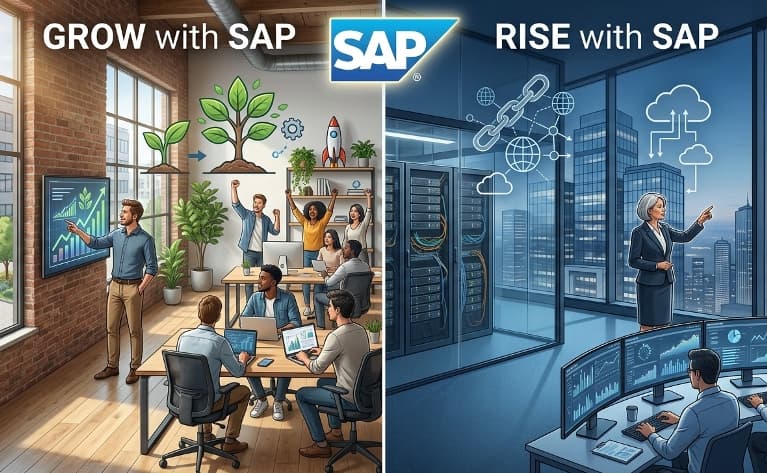
Both programs include SAP S/4HANA Cloud and access to the SAP Business Technology Platform, but the deployment model, target customer, and implementation approach are different enough that picking the wrong one can mean overpaying for capability you never use or hitting a wall once your processes outgrow the platform.
What is GROW with SAP
GROW with SAP is a package for organizations that have not previously run SAP and want to implement SAP S/4HANA Cloud Public Edition without a long, custom build.
It bundles the SAP Activate methodology, preconfigured best practice processes, and AI powered tools into one subscription so a mid sized business can go live without a large internal IT team.
The public edition behind GROW is multitenant, meaning SAP hosts and manages the infrastructure, security patching, and upgrades for every customer on a shared environment.
Businesses adopt SAP’s standard processes rather than heavily customizing the system, which keeps implementation timelines short but limits how far the software can bend to match unique workflows.
What is RISE with SAP
RISE with SAP, launched in 2021, is described by SAP as a Business Transformation as a Service package, and it centers on SAP S/4HANA Cloud Private Edition.
It is aimed at organizations already running SAP, particularly those moving off ECC or an on premise S/4HANA installation, that need more control over configuration than the public edition allows.
Private edition environments are single tenant, so each customer gets a dedicated instance rather than a shared one.
This approach allows companies to preserve the custom business logic and integrations they have developed over the years. However, it also puts more responsibility on the customer to manage implementation complexity and plan for future upgrades.
Deployment Model: Public Cloud Versus Private Cloud
The clearest technical difference between the two programs is who controls the infrastructure and how many customers share it.
GROW runs on a multitenant public cloud that SAP operates centrally, while RISE runs on a single tenant private cloud that can be hosted by SAP or, in some contracts, by a hyperscaler partner.
That distinction drives almost everything else. A shared public cloud environment only works if customers accept a common, standardized process, so GROW pushes businesses toward SAP’s default configurations.
A private, single tenant environment can absorb more customization because no other customer’s system is affected by changes made to it, which is why RISE fits organizations with established, complex ERP requirements.
Target Audience: Who Each Program Fits
GROW with SAP targets companies that are new to SAP entirely or that are running a non SAP system and want a fast, standardized ERP without a large implementation team.
It suits growing mid market businesses that can adapt their workflows to SAP’s built in best practices rather than customizing the software to match every existing process.
RISE with SAP targets current SAP customers, especially larger organizations or those with complex IT environments, who are migrating off ECC or an older S/4HANA deployment.
It fits businesses that need a phased, modular transition and want to keep more of their existing customization intact while still moving to a modern cloud platform.
Customization and the Clean Core Approach
GROW with SAP is built around adopting SAP’s standard processes with minimal customization, an approach SAP calls clean core.
The mindset behind GROW is essentially: learn the industry standard process and adjust the business to match it, rather than adjusting the software to match the business.
RISE with SAP allows for a more customized implementation that reflects a company’s existing processes more closely.
This tends to increase satisfaction with how well the system matches daily operations, but it also adds implementation complexity and duration compared to GROW’s standardized approach.
Implementation Timeline and Cost
GROW is designed to get a business live faster because it starts from preconfigured, standard processes and a shared cloud infrastructure that SAP already manages. Less custom configuration generally means a shorter project timeline and lower upfront implementation cost.
RISE typically takes longer to implement because private, single tenant environments support more customization, and customized systems require more configuration, testing, and change management.
Organizations already running complex SAP environments usually find that RISE costs more upfront but avoids forcing them to abandon business logic that took years to build.
AI and Automation Capabilities
Both programs now include SAP Business AI and the Joule assistant, so neither is a step behind the other on artificial intelligence access. The difference is how that AI reaches the customer.
GROW customers receive AI updates automatically as part of the regular public cloud release cycle, since SAP controls the shared environment and pushes new capabilities to everyone at once.
RISE customers manage their own private cloud upgrade schedule, which means adopting new AI native features requires a deliberate decision rather than an automatic update.
SAP has also positioned the RISE private cloud as the primary environment for running SAP Business AI at scale, while GROW puts more than 20 AI assistants in front of users from day one.
The 2027 and 2030 ECC Deadlines and Why They Matter
SAP ECC 6.0, Enhancement Packages 6 through 8, reaches the end of mainstream maintenance on December 31, 2027.
Extended maintenance is available after that at a cost premium and with a reduced scope of support, running through December 31, 2030.
This timeline is the main reason RISE with SAP exists as a distinct program. Companies still running ECC need a defined path off it before support narrows, and RISE was built specifically to carry existing SAP customers through that migration while preserving customization built up over years.
SAP has also introduced an ECC private edition transition option under RISE for large, complex customers who need to bridge support past the 2030 extended maintenance deadline, though that option requires signing a RISE cloud subscription contract.
GROW, by contrast, is not built around a migration deadline at all since it targets companies that were never running ECC in the first place.
Conclusion
The choice between GROW with SAP and RISE with SAP mostly comes down to where a business is starting from and how much customization it needs.
Companies that are new to SAP and can work within standard, best practice processes tend to move faster and spend less with GROW.
Companies already running SAP, especially those facing the 2027 ECC maintenance deadline or managing complex, customized processes, are usually better served by RISE.
Both lead to the same underlying platform, SAP S/4HANA Cloud, so the decision is really about entry point and complexity rather than long term capability.
Comments are closed, but trackbacks and pingbacks are open.