LPWAN is a broad category of wireless technology built for sending small amounts of data across long distances on very little battery power. LoRaWAN is one specific, open standard protocol that lives inside that category, alongside options like Sigfox, NB IoT, and LTE M.
It happens to be the most widely deployed of the group, with networks running in more than 100 countries. That popularity is exactly why the two names get used interchangeably, even though they describe different levels of the same system.
Knowing which is which matters once you are actually choosing a connectivity option, since it affects hardware cost, battery life, and how much data a device can send.
What is LPWAN?
LPWAN stands for Low Power Wide Area Network. It describes any wireless technology built to send small amounts of data over long distances while using very little battery power. It is a category, not a single product or protocol.
Several technologies fall under the LPWAN umbrella, and each one makes different tradeoffs around licensing, cost, range, and data rate. The main options include:
- Sigfox: a proprietary network that sends very small packets, up to 12 bytes, over unlicensed spectrum.
- LoRaWAN: an open standard protocol built on LoRa radio technology, supporting larger payloads and flexible deployment.
- NB IoT (Narrowband IoT): a licensed cellular technology run by mobile carriers.
- LTE M: another licensed cellular option, built for slightly higher data rates than NB IoT.
A device manufacturer picking an LPWAN option is really choosing among these specific technologies.
The term LPWAN itself does not tell you anything about how a device connects. It only tells you the general category of tradeoffs you are working with: low power, wide coverage, and low bandwidth.
What is LoRaWAN?
LoRaWAN (Long Range Wide Area Network) is a specific, open standard communication protocol built on top of LoRa, the radio modulation technology developed by Semtech. It is maintained and certified by the LoRa Alliance, a nonprofit industry group.
Where LPWAN is a category, LoRaWAN is a defined set of rules for how devices join a network, how they communicate securely, and how data moves between an end device, a gateway, and a network server. That standardization is what makes LoRaWAN products from different manufacturers work together.
LoRaWAN networks now run in more than 100 countries through 70 plus network operators. A single LoRaWAN gateway can connect thousands of end devices, and battery powered sensors on the network commonly run for two to five years without a battery change.
How LoRaWAN Fits Inside LPWAN
The confusion between these two terms usually comes from how often people say “LPWAN” when they actually mean “LoRaWAN,” or the reverse. Here is the relationship stated plainly: every LoRaWAN network is an LPWAN, but not every LPWAN is a LoRaWAN network.
Think of LPWAN as the word “vehicle” and LoRaWAN as the word “sedan.” A sedan is a vehicle, but plenty of vehicles are not sedans. In the same way, LoRaWAN is one type of LPWAN, sitting next to Sigfox, NB IoT and LTE M as options within the same broad category.
Range, Power, and Data Rate Compared
Each LPWAN technology makes different tradeoffs. The table below lays out how LoRaWAN compares with the two other major LPWAN options on the criteria that matter most for IoT deployment.
| Criterion | LoRaWAN | Sigfox | NB IoT / LTE M |
|---|---|---|---|
| Spectrum | Unlicensed | Unlicensed | Licensed cellular |
| Typical range | Up to 15 km in rural, line of sight conditions | Similar long range, smaller payload | Depends on carrier tower density |
| Payload size | Up to 230 bytes at data rates up to 50 kbps | Up to 12 bytes per message | Larger payloads, higher data rates |
| Network ownership | Public or private, operator or self hosted | Public network only | Public carrier network only |
| Message limits | Set by network capacity, no fixed daily cap | Up to 140 messages a day on standard plans | Set by carrier data plan |
| Ongoing cost | No mandatory subscription with a private network | Subscription required | Carrier subscription required |
The core tradeoff is straightforward. LoRaWAN and Sigfox both run on unlicensed spectrum and avoid mandatory carrier fees, but they trade off maximum data rate for battery life and range.
NB IoT and LTE M use licensed cellular spectrum, so they cost more to run but plug into existing carrier infrastructure.
Who Should Use LoRaWAN
LoRaWAN fits use cases where devices send small, infrequent bursts of data and need to run on a battery for years.
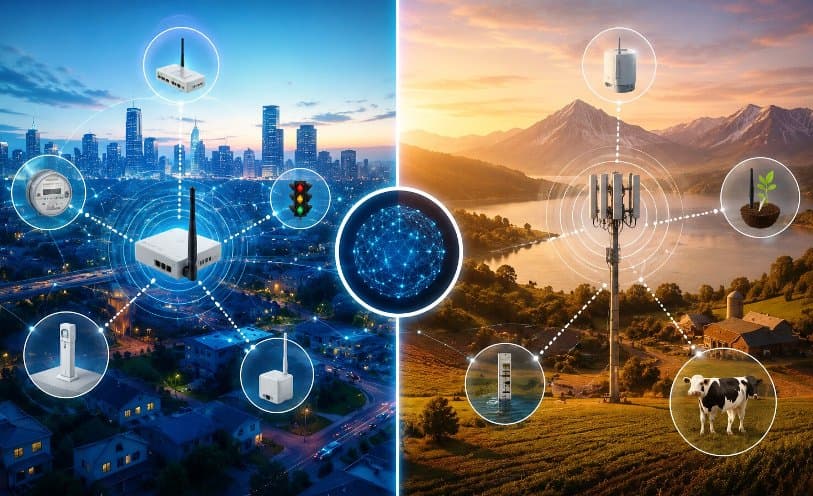
Common examples include soil moisture sensors in agriculture, utility meters, asset tracking tags, and environmental monitors in smart city deployments.
If a project needs to send large payloads, stream data continuously, or guarantee carrier grade coverage without deploying private gateways, a cellular LPWAN option like NB IoT or LTE M is usually the better fit.
Conclusion
LPWAN is the category, and LoRaWAN is one protocol inside it. If a project needs long battery life, long range, and low ongoing cost, LoRaWAN is usually the strongest starting point among LPWAN options.
If it needs guaranteed carrier coverage or larger data payloads, a cellular LPWAN option like NB IoT or LTE M is worth evaluating instead.
Knowing which term describes the category and which describes the specific protocol makes it much easier to have a precise conversation with vendors and engineers.
Comments are closed, but trackbacks and pingbacks are open.